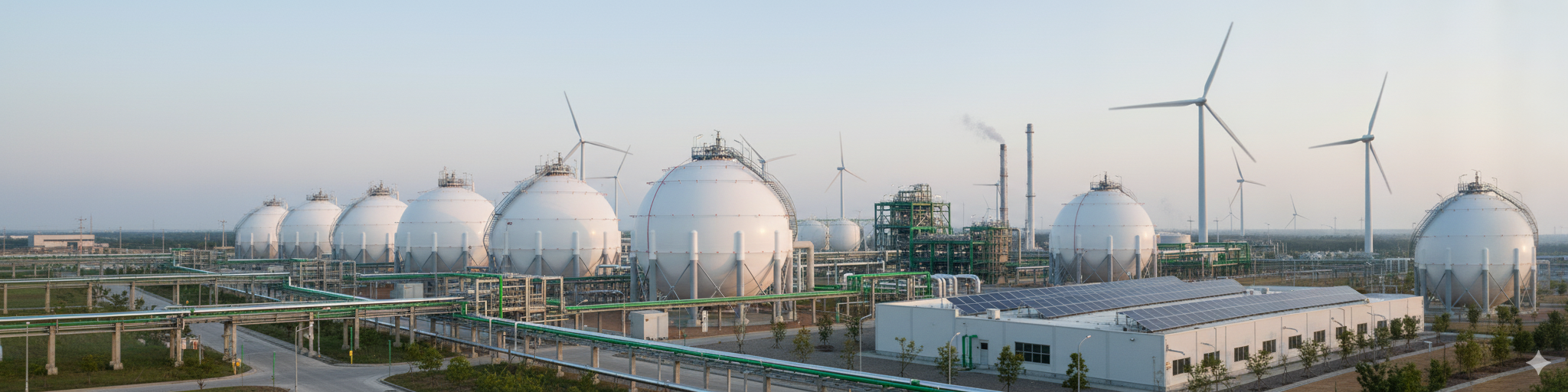







Algae Biotechnologies has developed the world's first integrated seaweed cultivation and biorefinery system capable of producing high-volume, low-cost biomethane and biohydrogen, while simultaneously recapturing CO₂ within the production process itself.
The Algae Biotechnologies biorefinery outputs can span: biomethane, biohydrogen, biostimulants, animal feeds, human foods, cosmeceuticals, pharmaceuticals and nutraceuticals. This is not just an incremental improvement, it is the offering of a categorically different approach to industrial bio-product production, with a negative emissions potential that no competing system can replicate.

The energy transition has a green gas problem.
The global transition away from coal and oil has created enormous and growing demand for natural gas as a bridging fuel. LNG demand is rising. Grid gas consumption remains at scale. Whether pipeline or liquefied, the environmental profile of fossil-derived natural gas is structurally incompatible with net-zero commitments. Based on volume, economics and rising security challenges, there is an urgent demand for self-sourced, high-output, low-cost green gas… and existing technologies are not scaleable or cost-competitive at the margins that matter.
The gap between ambition and available supply has not been closed. Until now.
The problem facing Green Gas:
-
Conventional biogas (derived from agricultural waste, food waste and sewage) is supply-constrained. Based on not only land-footprint, output and feedstock supply constraints, the organic waste available to urban Anaerobic Digestion (AD) systems cannot produce biomethane at the volumes required to meaningfully displace fossil gas at national or regional scale.
-
The largest biogas on the planet outputs 100MW in power. A small power station is minimum 20x this output. Green gas premiums are policy-dependent… and policy changes often. A commercially viable green gas system must be cost-competitive without subsidy dependence.
-
Most biogas systems are carbon emitters. CO₂ produced during digestion is vented or released. The environmental case for conventional biogas rests on the low energy production processing of waste.
What Is Required:
A green gas production system that is feedstock-dependent (and independent from constrained waste streams), cost-competitive with fossil gas at scale and capable of absorbing rather than emitting CO₂.
This is the specification that Algae Biotechnologies was built to meet.
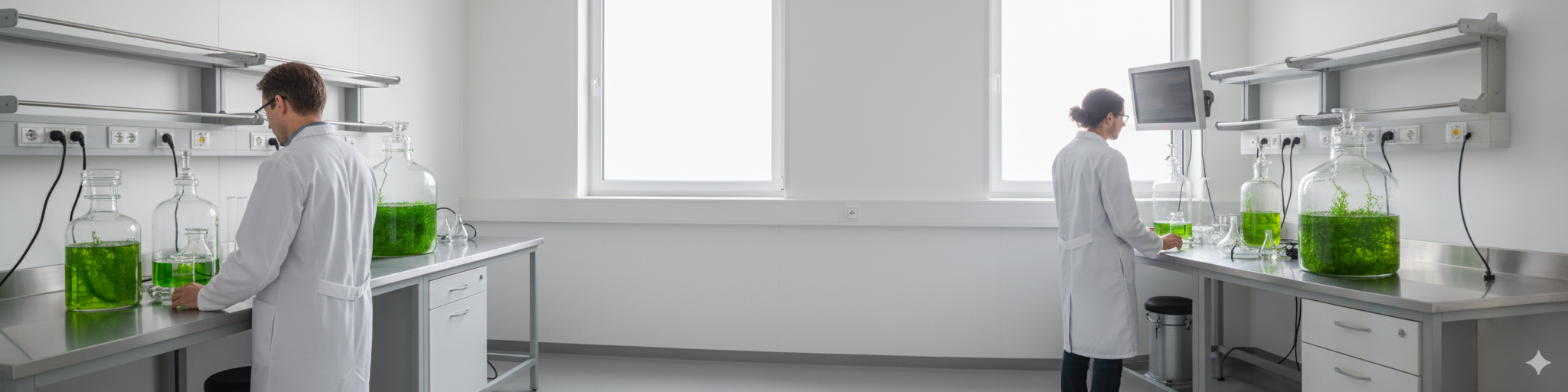
Two systems. One closed loop. Zero atmospheric CO₂ release.
The Algae Biotechnologies platform integrates two proprietary systems:
The Hygen Bioreactor (HBR), a high-rate mesophilic digestion system operating at 85–90% volatile solids destruction, invented and patented by Dr. N. Bartlett; and
The terrestrial, in-tank continuous seaweed cultivation system developed and patented by Dr. D. Kalkwarf;
Together, they form a closed-loop production cycle:
Macroalgal seaweed grown as HBR feedstock absorbs marine carbon during photosynthetic growth;
the HBR degrades the organic material into base acids for downstream products or biomethane/biohydrogen for energy;
CO₂ generated during energy production is captured by microalgae photosynthesis and is either refined into downstream products or returned as nutrient input for the next seaweed growth cycle;
Zero waste. Zero emissions.
The Solution:
-
The seaweed cultivation system developed by Dr. D. Kalkwarf enables continuous, high-density growth of marine macroalgae within terrestrially-based controlled tank environments, eliminating any dependence on ocean harvest, weather or seasonal growing cycles. Currenty cultivated seaweed systems demonstrate growth rates four times that of wild-harvest seaweed, providing a predictable, scalable feedstock supply independent of marine conditions. The seaweed absorbs marine carbon during photosynthesis as its primary biological input.
Cultivation tanks can be deployed on non-agricultural land, in coastal industrial zones or alongside existing water infrastructure. The seaweed feedstock does not compete with land, freshwater or agriculture for any resource.
-
What It Does: The HBR is a high-rate industrialised fermentation system operating under mesophilic conditions at 37°C. It processes cultivated seaweed biomass through four biochemical stages: hydrolysis, acidogenesis, acetogenesis and methanogenesis and produces biogas with upwards of 70% methane content. The system achieves 90–95% volatile solids destruction in 7 days: a retention time four times shorter than conventional CSTR systems, with zero solid digestate output.
Why It Matters: Conventional biogas production requires 25–60 days of hydraulic retention time, produces significant solid digestate requiring secondary disposal and achieves only 50% volatile solids destruction. The HBR's 7-day cycle and zero-solids output can reduce plant footprint by 70% and capital expenditure per tonne by 15–20%, proving the economic case for commercially viable large-scale seaweed digestion.
-
The Algae Biotechnologies photobioreactor system developed by Dr. R. Orozco captures the CO₂ stream produced during HBR digestion and routes it into a micro-algae cultivation system. Micro-algae consume this CO₂ through photosynthesis at high rates, producing algal biomass that is either refined into downstream products (biostimulants, nutraceuticals, cosmeceuticals) or returned as a nutrient-rich organic input to the seaweed cultivation system, closing the loop entirely.
Through dark fermentation and photo-fermentation stages, this organic matter can be directed toward biohydrogen production rather than methane, enabling the same platform to serve hydrogen fuel cell markets, industrial hydrogen demand and green hydrogen infrastructure as those markets develop. The residual organics from HBR processing, combined with micro-algae biomass not directed to products, form the nutrient substrate for continuous seaweed cultivation, ensuring zero waste at every stage.
The HBR platform is not a single-product system. It is a configurable biorefinery, the output mix of biomethane, biohydrogen and high-value biological products determined by market conditions and offtake agreements, not by fixed technology constraints.
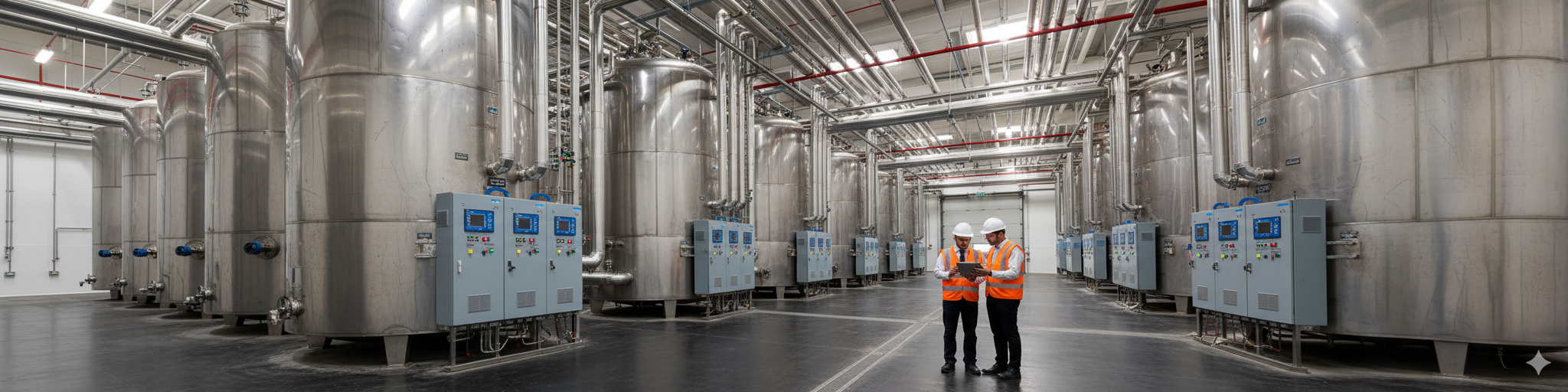
Every other biogas system releases CO₂. This one consumes it.
Biogas production of organic matter releases biogenic CO₂ as an unavoidable biochemical byproduct. Algae Biotechnologies eliminates this contradiction. The CO₂ produced within the HBR digestion process is captured and delivered directly to the micro-algae PBR, where it is consumed by photosynthesis as a biological growth input. The carbon does not leave the system boundary.
Fixing CO₂
-
The HBR breaks down seaweed biomass through advanced fermentation, releasing methane (the energy product) and CO₂ (the byproduct). In a conventional system, the CO₂ stream is separated during gas upgrading and released to atmosphere.
-
In the Algae Biotechnologies system, the CO₂ stream from the HBR is routed directly to the micro-algae photobioreactor (PBR). Micro-algae (among the fastest-growing photosynthetic organisms on the planet) consume CO₂ at exceptional rates as their primary carbon input, producing biomass continuously.
-
Harvested micro-algae biomass is either refined into downstream products (biostimulants, nutraceuticals, cosmeceuticals) or returned as nutrient-rich organic input to the biomass fermentation system, feeding the next generation of seaweed growth. The carbon fixed from CO₂ re-enters the biological cycle rather than the atmosphere.
-
At full system boundary accounting… including the fossil fuel energy displaced by the biomethane produced… the Algae Biotechnologies system achieves negative atmospheric CO₂ impact. This is not an offset. It is a function of the core production process.
No government with a net-negative emissions commitment, no investor with a beyond-zero mandate and no campaigner for meaningful climate action can find an equivalent system anywhere in the market.
This is the singular competitive position of Algae Biotechnologies.
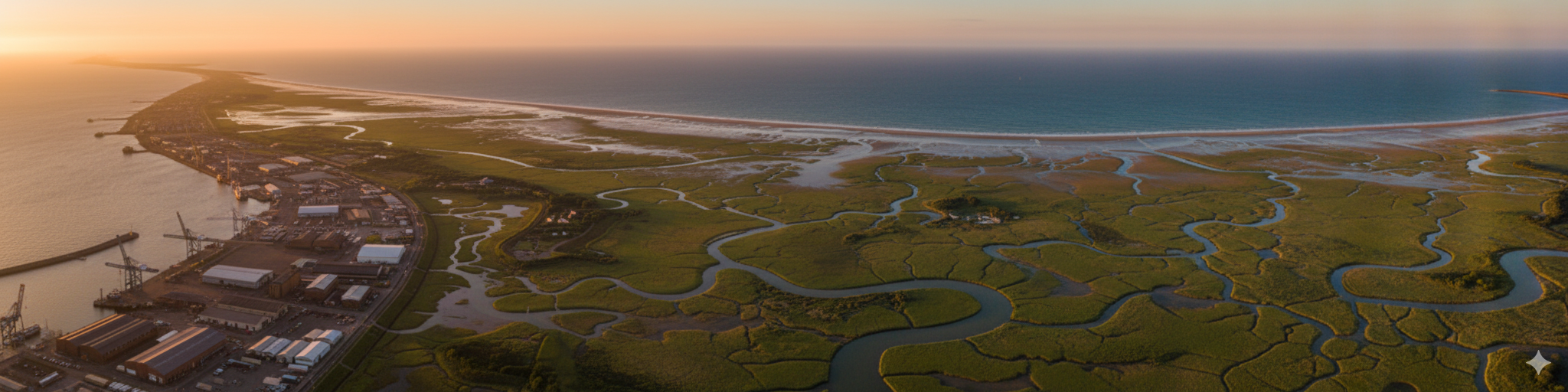
Britain's gas network is one of the largest ready-market for green gas in the world. Algae Biotechnologies can build the system to supply it.
The United Kingdom consumes approximately 65 billion cubic metres of natural gas (heating, power generation and industrial processes) per year. Under the Climate Change Act and the UK's legally binding net-zero commitment for 2050, the entire fossil gas supply must be progressively replaced. Green gas grid injection is the only scalable pathway to decarbonise gas demand, without replacing the infrastructure that delivers it to 23 million homes and thousands of industrial sites. The volume required is enormous. The current supply of biomethane is a fraction of what is needed.
Algae Biotechnologies is building the production system to close this gap.
Market Option 1: The United Kingdom
-
The North West England region, encompassing Greater Liverpool, Merseyside, Lancashire and Cheshire, presents the optimal conditions for initial HBR seaweed deployment in the UK. The region has direct access to marine water sources for seaweed cultivation, established industrial infrastructure suitable for large-scale green gas production, existing gas network interconnection points for biomethane grid injection and a policy environment at both mayoral and national level actively seeking credible low-carbon energy solutions at scale.
-
By removing CO₂, H₂S and moisture to achieve greater than 97% methane content, biomethane produced by the HBR system is upgraded to natural gas specification and injected directly into the local gas distribution network. No new infrastructure is required at the consumer end. The 23 million homes and industrial sites already connected to the gas network receive decarbonised gas through existing pipelines, boilers and appliances.
-
The Liverpool City Region Combined Authority has expressed active interest in the development of large-scale green gas infrastructure as part of its net-zero and economic development agenda. The port infrastructure of the Mersey estuary and the industrial land availability of the wider city region provide a physical development environment well-suited to the first commercial HBR seaweed facility.
-
Biomethane grid injection in the UK is governed by the Gas Safety (Management) Regulations 1996, the Green Gas Support Scheme (GGSS) and Ofgem's gas quality and network entry standards. The HBR system is designed to produce gas fully compliant with these standards. The Green Gas Support Scheme provides a tariff-based incentive for biomethane injection, providing revenue certainty for project financing.
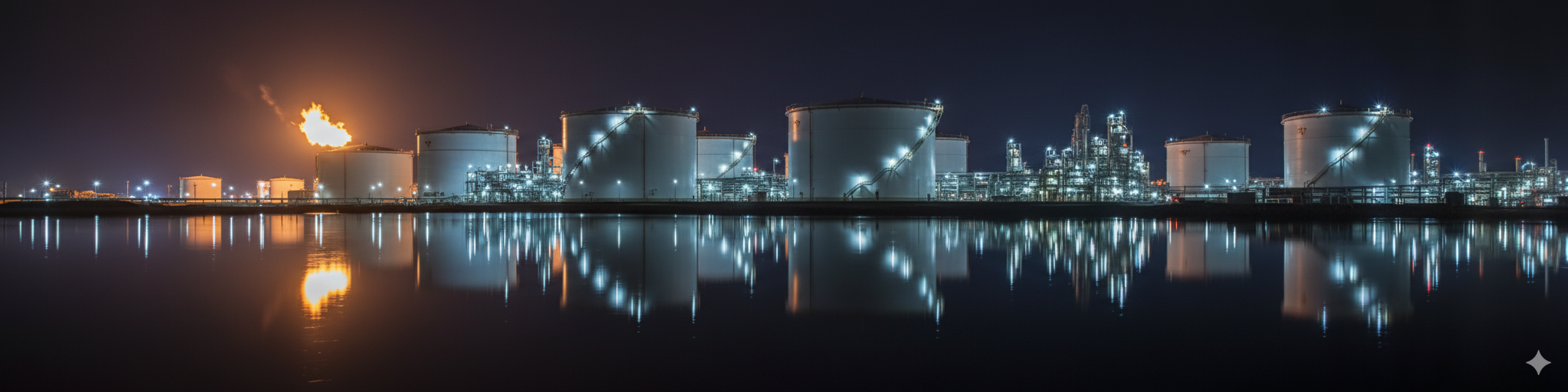
The world's largest LNG producers face a common problem: their product's environmental profile is incompatible with the commitments of the nations buying it. Bio-LNG is the solution.
Qatar produces more than 100 million tonnes of LNG per year. It boasts the largest single LNG export programme in the world. The energy-importing nations that purchase this LNG: Europe, Asia and beyond are operating under progressively stringent carbon accounting requirements. The carbon intensity of imported LNG is increasingly a procurement criterion, not merely an environmental consideration. Gulf LNG producers that cannot demonstrate a credible decarbonisation pathway for their export product face long-term demand risk from their most significant customers.
Bio-LNG blending is the only near-term solution that does not require replacing existing production, shipping or import infrastructure.
Market Option 2: The Gulf
-
Bio-LNG is the upgraded output of the Algae Biotechnologies HBR system. It is produced by liquefying biomethane to the same specification as conventional LNG. It is chemically identical to fossil LNG in energy content, combustion behaviour and infrastructure compatibility. A blend of Bio-LNG and conventional LNG reduces the carbon intensity of the blended product in direct proportion to the Bio-LNG fraction, with no modification required at the liquefaction terminal, the LNG carrier, the import terminal or the end-use facility.
-
Algae Biotechnologies has conducted advanced engagement with energy sector stakeholders regarding the development of a Bio-LNG blending programme. The strategic rationale is compelling: The Gulf has the infrastructure, the export volumes and the sovereign motivation to be the first major LNG producer to offer a verified low-carbon LNG product to international buyers. The technology exists. The feedstock model is proven. The commercial structure is straightforward.
-
Even a 10% Bio-LNG blend in The Gulf’s LNG export programme would represent a green gas volume many times larger than the entire current global biomethane production capacity. This is the scale at which the Algae Biotechnologies seaweed cultivation and HBR system becomes relevant to Gulf producers… not as a niche green energy product, but as a strategic tool for maintaining market access in a carbon-constrained world.
-
The Algae Biotechnologies model: seaweed cultivation in coastal waters, HBR fermentation, biomethane liquefaction is well-suited to Gulf climate and coastal geography, where seaweed growth rates in warm marine environments can substantially exceed those achievable in Northern European conditions.

Market Option 3: The Rest of the World
Every coastal nation with a gas network, an LNG import terminal, or a net-zero commitment is a potential deployment market. The feedstock is the ocean.
The Algae Biotechnologies seaweed cultivation system is not geographically constrained. Marine macroalgae grow in every ocean on the planet. The conditions required for commercial cultivation: access to marine or brackish water, adequate light, CO₂ supply from the HBR system exist in coastal regions across Asia, Africa, Latin America and the Pacific. The HBR system itself is modular and scalable, deployable at any site with appropriate water access and grid or distribution infrastructure. The global addressable market is not a projection, it is a function of where coastlines and energy demand intersect, which is everywhere.
Horizon 1: UK & Europe
Biomethane grid injection across the UK and European gas networks.
EU REPowerEU targets require 35 billion cubic metres of biomethane production by 2030, a target that cannot be met from waste feedstocks alone. Seaweed-derived biomethane from HBR systems deployed in coastal European waters addresses this supply gap directly.
Horizon 2: Gulf & MENA
Bio-LNG production for blending with Gulf export programmes. Saudi Arabia, UAE, Oman and Qatar all have the incentive, the coastal geography and the infrastructure to integrate seaweed-to-Bio-LNG production into their existing LNG operations. The Gulf and Red Sea’s coastal waters present high seaweed productivity potential year-round.
Horizon 3: Asia & Pacific
India's SATAT framework provides a sovereign offtake mechanism for compressed biogas. Japan, South Korea and Singapore are all major LNG importers with advanced net-zero commitments and represent potential Bio-LNG import markets. Coastal nations with high fisheries and aquaculture infrastructure are natural seaweed cultivation partners.

Why Seaweed Scales
Seaweed is the high-volume answer for biomass supply: it is not geographically fixed, seasonally variable and already contested between competing uses: composting, direct land application thermal treatment. Seaweed can be cultivated at any scale in any coastal location, harvested continuously and grown specifically for fermentation without competing with food, agriculture or any other biological resource system. This is why seaweed is the feedstock for a genuinely global green gas industry at planetary scale.
The Scale of the Opportunity
Global Emissions, Carbon Sequestration & Hydrogen
-
Global combustion of natural gas released approximately 8.1 billion tonnes of CO₂ in 2023, representing the single largest addressable market for green gas substitution. Unlike coal displacement, which requires fuel-switching infrastructure at the point of use, green gas and Bio-LNG are “drop-in” replacements requiring no change to existing boilers, turbines, vessels or appliances. The HBR seaweed platform is designed to address this market at a scale that waste-based biogas cannot approach.
-
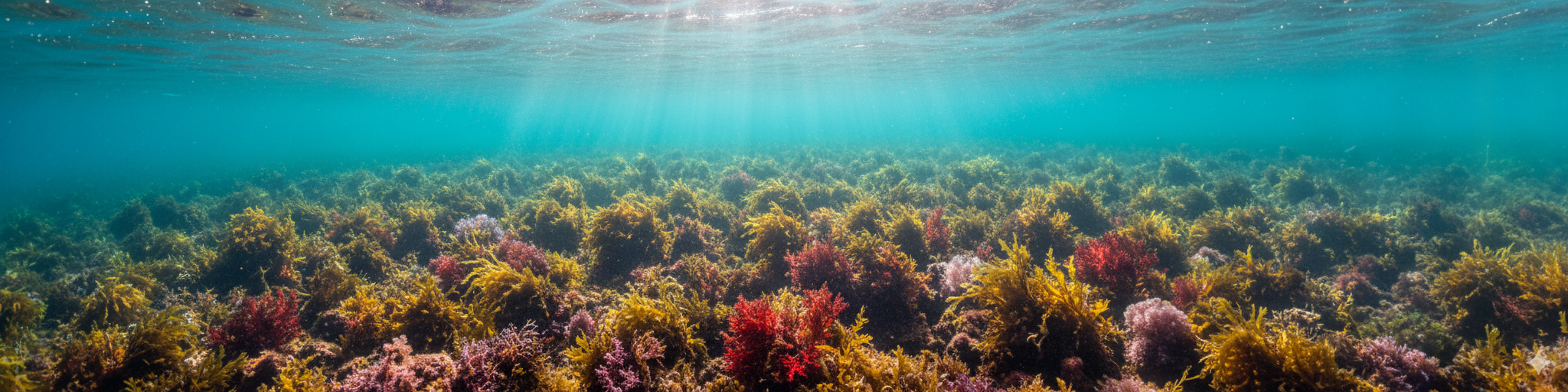
Scientific modelling consistently identifies large-scale seaweed cultivation as one of the few biological mechanisms capable of carbon sequestration at gigatonne scale. The Algae Biotechnologies cultivation system adds a dimension beyond sequestration: the carbon absorbed by seaweed during growth is not simply sunk, but converted into energy, products and further biological mass. The carbon is productive, not merely stored.
-
The photobioreactor pathway developed by Dr. R. Orozco enables the same seaweed cultivation and HBR infrastructure to produce storable biohydrogen, a zero-emission fuel for sectors where direct electrification is not viable: heavy industry, shipping, aviation, and long-distance freight. As global hydrogen infrastructure develops, the AB platform is positioned to supply it from a seaweed feedstock that requires no freshwater, no arable land and no fossil fuel input to produce.
-
The system produces no waste stream requiring external disposal. Residual organics from HBR processing are returned as nutrient substrate to the seaweed cultivation tanks. Micro-algae biomass produced in the photobioreactor is either refined into high-value biological products (biostimulants, nutraceuticals, cosmeceuticals) or similarly recirculated. The system boundary is genuinely closed. Every input becomes an output of value.
Team
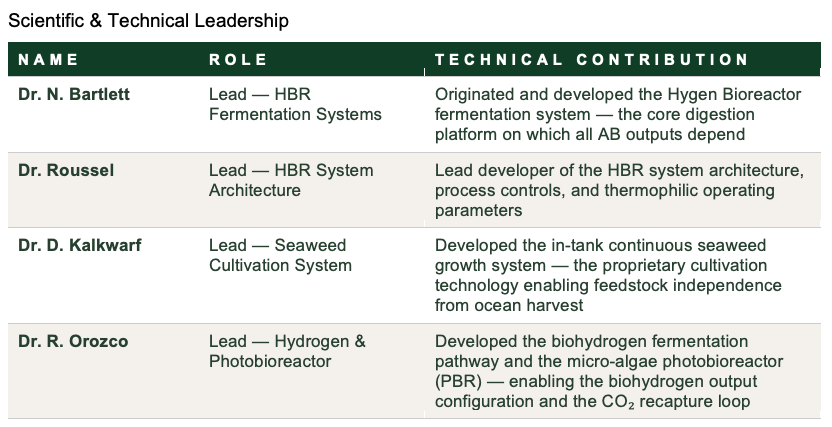
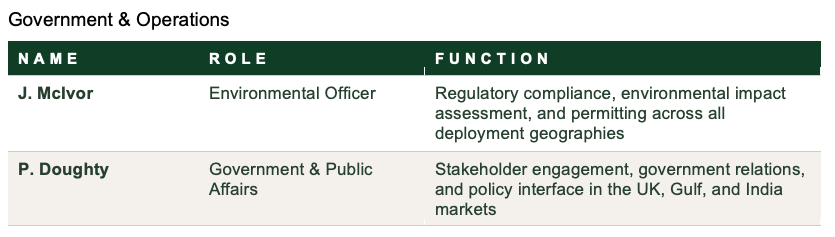
In conjunction with the Universities of Chester, Birmingham, Edinburgh and Lancaster, Algae Biotechnologies was built by scientists and environmentalists. The HBR system, the seaweed cultivation process, the photobioreactor and the hydrogen fermentation pathway were each created by members of this team, giving the organisation a depth of technical ownership that cannot be replicated through licensing or partnership alone.

The technology is ready. The markets are open. The window for deployment partnerships is now.
Algae Biotechnologies is actively seeking engagement from governments, energy system operators, sovereign investors and development finance institutions across the United Kingdom, the Gulf and global deployment markets. The HBR platform is at commercial development stage, past proof-of-concept and ready for scaled deployment with the right strategic and capital partners. Technical briefings, project co-development discussions and offtake framework negotiations are available to qualified parties.
Who Should Engage:
Engage with us
-
• National governments and devolved authorities with net-zero mandates requiring domestic green gas supply at scale;
• Energy ministries and regulators in LNG-exporting nations evaluating Bio-LNG as a product differentiation and market retention strategy;
• City and regional governments in the UK with industrial land, water access and green energy development objectives;
• Multilateral development banks and UN agencies with energy transition, climate finance or SDG-aligned infrastructure mandates;
-
• Gas network operators and energy utilities in the UK requiring biomethane at grid-injection volumes under Green Gas Support Scheme;
• Industrial energy consumers seeking long-term supply agreements for low-carbon gas at competitive pricing;
• LNG producers and traders in Qatar, UAE and the Gulf seeking Bio-LNG blending supply and carbon intensity reduction for export product;
• Seaweed aquaculture operators and marine biotechnology companies exploring cultivation partnership structures;
-
• Sovereign wealth funds with energy transition and net-zero portfolio commitments
• Infrastructure funds and development finance institutions with UK, Gulf, or South Asia mandates
• Carbon market participants and voluntary offset purchasers seeking net-negative verified credits at institutional volume
Green bond issuers and sustainability-linked finance structures seeking eligible project assets
-
• Universities and national laboratories with anaerobic digestion, marine biology, or photobioreactor research programmes
• Technology licensing partners in geographies where direct deployment is not the near-term pathway
• EPC contractors and engineering firms with biogas, LNG, or marine infrastructure experience relevant to initial deployments
Request a Briefing
Qualified enquiries from government bodies, investment institutions and energy sector partners are invited to request a formal technical briefing. Briefings are available in person in the United Kingdom and via secure video conference for international counterparts. All engagement is conducted under mutual NDA.
Investment details, project financial structures, and deployment timelines are available under non-disclosure agreement to verified institutional and government counterparts only.
Contact: Jamie McIvor, Environmental Officer